

12 December 2008
Follow Up

10 December 2008
Lives
Almost all my adult life, I've mused on the question of whether people who behave badly toward other people, or who make what these days are called "bad choices" actually are unhappier than other people. My mother firmly believes that people who are mean or unkind, or who behave cruelly to others without caring, are actually sadder than people who do not -- that is, that they carry a sadness they are somehow aware of, and it sort of niggles at them and makes them unhappy, even if they think unhappy is "the way I am," or even if they can't identify the source of the niggling/sorrow. But I'm not sure that's true. I'm not saying I believe it's not true, but I've known a lot of people who behaved badly, or rudely, or stupidly, towards others, and they don't seem sadder than anybody else. In fact, sometimes they seem happier - perhaps because they've managed to build up such a successful carapace that they don't notice how they're acting.
A more difficult question, though, is what happens to people who make unwise choices. I think here, for example, of people who don't take chances. Now, those people certainly have smaller lives than people who do take chances, which seems sad. But a part of me is inclined to say that those people are in fact perhaps happier than those who take chances. If you think, "Well, I could go to the city, or I could stay here on the farm," and you choose to stay on the farm because it's familiar and safe, aren't you happier? You've stayed somewhere familiar and safe, and you've never run the risk of encountering sorrow in the city. Sure, your life is empty of what you might have found in the city, but if you think what you have is good, are you really emptier because of what you've possibly missed?
And of course I wonder this most of all with relationship choices. My best friend told me once that she believed many, if not most, people who were in relationships were in unhappy relationships, or were unhappy in their relationships: I took this to mean that they had festering issues, or that they'd chosen someone they had later come to dislike, but stayed with them out of fear. But there are also frequent instances of someone taking the first person they can find, even if that person is not what they would have wanted, and I had a therapist once who told me a study had determined that most people simply end up with someone who lived near them: what people seem to use as the most deciding factor is propinquity. I knew someone once who told me that for the last two years he'd been with his ex-girlfriend he'd been angry. And my ex-boyfriend J. told me earlier this year that he was moving in with the woman he'd been seeing for x number of years, and that he supposed they'd become engaged shortly after and then get married, although he "wasn't looking forward to the marriage." In both of these latter cases, I'd say the relationship (or any future relationships, in case A) were going to be unhappy. If you aren't looking forward to getting married (and, well, the structure of J's remark suggested to me that he retained serious issues with intimacy), then I don't think your marriage will be particularly happy (although we should cut some slack for the possibility that after you get into it you find you love it). If you stay in a relationship angry for two years, that suggests you have some difficulty articulating your emotions, not to mention lack the courage to exit a bad relationship, and that suggests you're going to have relationships full of pent-up rage and sorrow, which would seem to suggest you would be unhappy in them (although we should cut some slack for the possibility that you might meet someone you'll be less angry with).
But...what if that's not true? What if people find some equilibrium, as we all do, and that equilibrium is simply lower? J. is unhappy to get married, but what if he accepts that getting married is something you do, and he does it, and that unhappiness gets balanced against other things, and gets balanced out? I would say, "Get yourself some therapy to figure out why you don't want to get married, deal with your problem, and then you'll be happy," but maybe I'd be wrong. What if Case A simply goes through life ignoring his rage - or dissatisfaction - so that it becomes a kind of dull background that he lives with? Isn't he then happy? If your unhappiness is ignored, or if you think of it as something that is your lot, aren't you then happy? What if all those people who opt for the safe relationship over the potentially fabulous one, and thus never know how fabulous their lives might have been, are happy in their safety? - After all, they'll never know what they're missing.
Most people aren't risk-takers; my therapist told me that, too. Yet most people are happy. Are they less happy than risk-takers? We're all encouraged to become cultured, and intellectually rich, yet the fact is that if you do become cultured and intellectually rich you seriously decrease your circle of possible friends. This would seem to suggest that the unenlightened are in fact better off than the enlightened. People who stand up for themselves in relationships, and people who don't want to get married and thus don't, end up alone. That would seem to suggest that people who keep their mouths shut or accept fundamentally sucky things are happier than those who don't (bear in mind here that I'm not talking about accepting stuff you don't like about your partner and learning to live with it; everyone does and ought to do that. But marrying someone when you're reluctant to get married strikes me as potentially much more major than accepting your partner's ugly jumpers or hacking cough).
I guess I'm inclined to believe that people who lead limited lives, or repressed lives, are unhappy and know it. But I believe that because, as a person who doesn't lead a limited or repressed life, and a person who is alone and unhappy, it's in my interest to believe other people are more unhappy than I. You know, the English complain and whine all the time to each other, but never to the authorities, and I find that unfathomable. If you don't like a situation, do something to change it in some active way (and if that doesn't work you've earned the right to whinge). But they certainly like moaning to each other; are they less happy than I, who try to change situations, can't change them, and am angry about it?
Perhaps you have to take the measure of yourself. Perhaps J. knows he doesn't want to get married, but also knows he doesn't want to be alone, so he accepts that he'll be unhappy in a tiny way but the result will balance it out. Perhaps Case A knows it would be better if he spoke his anger, but it's more important to him to be with the person, or he also knows he's not the sort of person who can risk speaking negative emotions, so he accepts the unhappiness for the greater contentment.
I was watching Pushing Daisies tonight, and one of the characters said, "You no good to somebody else unless you're good being with just you," and I thought what wise advice that was, and how true (inner resources making the success of the outward-directed person). But thinking it over it seemed to me that people who are no good at being with just themselves are always with someone else; they're never alone. So one conclusion would be, They're less lonely.
I don't know.
08 December 2008
Frost

Today for the first time the frost stayed on the ground all day. Frost freezes the grass, of course, so when you walk over it it feels crunchy beneath your feet. I love that sensation, and feeling it reminded me (as if I need reminding) of how much I love snow. When I lived in England all those years ago, the only snowfall we got was a tiny little dusting; I was so disappointed! Now I'm more savvy about snow in the Southeast of England, so I don't suppose we'll get any at all, and that's fine. But I still like it, and I can never understand people who don't.
When I was little, one year there was a blizzard in Philadelphia. Indeed, for a while this blizzard was famous as the most fierce Philadelphia had had (this record has long since been eclipsed). I remember that the day after the snowfall there was bright sunshine - as there often is the day after a blizzard. In our backyard, the sun melted the top of the snow into one of those thin smooth sheets of ice that makes the snow even and makes it look solid. And that's exactly how it looked to me. I remember going down our long back steps until I reached the top of the snow and stepping on it, expecting it to hold my weight, and sinking down into it up to my waist. Of course, I was short then, so who knows how high the snow actually was, but at the time that - both the height and the sinking - were astounding to me. Perhaps that's why I still love snow.
But frost is good, too. Crunchy. Yay, frost!
05 December 2008
American Things
As you know, I prefer England to America. It will not be surprising for you to learn, then, that I pretty much think the English get things right, and think that most of what one can get in America can be found - perhaps even in a better version - right here. Sometimes, though, even I must admit that that just isn't true. So I've decided to devote tonight's long-overdue entry to
American Stuff I Think They Ought to Have Here
1. Top of the list has to be ruled 5"x8" pads with stiff backing and a paste top.

For some reason, this most convenient of items is not to be found here. I can get a pad with a spiral top (a disaster, as the top gets squashed, or its little end catches on stuff in one's bag), but that's really a steno pad; they even call it that. And not only is it a steno pad, it's a steno pad without a stiff back, so you have to put it on a surface, or do the old "support it with your hand ineffectually" thing, in order to write on it. These American memo pads are just the right size for making lists or taking small notes, and the back is stiff enough to facilitate that. Make them here! You could just call them 127 x 203mm pads.
2. Queen Helene Cocoa Butter Creme. Not only does the name rhyme, but it's the best skin cream I've ever used. It comes in two versions: thick and lotion-y. Each is wonderful,

and you can also use the thick one as a deeply moisturising face cream. Here they have Palmer's Cocoa Butter, which smells like brown sugar and is therefore repellent. It's unnatural to smell like brown sugar! Queen Helene Cocoa Butter Creme smells deliciously like coconut, or cocoa nuts, and it works a treat. Fortunately I brought a jar of the thick stuff with me for the winter, but in the summer I was forced to use a variety of inferior skin lotions. I'm already worried about what I'll do next summer. Tense times, I'm sure you'll agree.

3. PaperMate Stick Pens in fine point. You can get the yellow Bic ones, but those are hexagonal, and the ridges hurt my finger. Why can't you get the nice round stick pens, either those opaque blue or black ones, or the almost-transparent thicker kind? It's a mystery. PaperMate, be great: sort this one out! (see how I made a little rhyme there?)
4. L'Oreal Nice 'n' Easy Hair Dye #111, Natural Medium Auburn. To be fair, this was hard to find in the States, too, but at least I could order it on the net. Here, nothing! Actually, the hair dye section of drugstores/chemists have always thrown

me off. Normally I like the abundance of a good pharmacy, but I always find that section a bit overwhelming. You go in, and there's a dazzling array of hair colour possibilities: who knew there were so many shades of brown? And I do mean so many shades, because every company's colours are different, so that the light brown of Revlon is notably different from the light brown of L'Oreal. And if you use red hair dye the anxiety level is ratcheted up, because the majority of red hair dyes are of the variety that don't even try to look natural: apparently most women prefer to look as if they've spilled a glass of wine on their heads, or dumped some red Rit dye (I bet they don't have that here, either) in with their hair product. So I stand there in the dye aisle trying to sort out the sheep from the goats, and it's all a bit much. But at least in the States I can buy a colour I know, from many years of testing, is the one that works. Here, no such look. I'm gearing myself up to try Garnier Nutrisse Copper Brown, but over the Christmas break, so if it all goes horribly awry no one will be here to see (fortunately, I still have two boxes of Nice 'n' Easy, brought from the States. But, come on - hoarding hair dye? Has it come to this?).
5. Chocolate Double Stuf Oreos. Sainsbury's carries regular Oreos, but apparently not

Double Stuf, and certainly not Chocolate Double Stuf. I see from a bit of a cruise round the net that Oreos were introduced in the UK in May of this year, but there were concerns that their taste would not appeal to the British palate as much as the Bourbon cream biscuit. Now as it happens Bourbon creams are one of my favourite biscuits, and they do resemble the chocolate Oreo: imagine a single stuff Oreo with a drier and less highly sugared biscuit and cream. The best way to eat Bourbon cream is, in fact, much like the best way to eat an Oreo: pop off the top biscuit (although in the case of a Bourbon you have to do this with a bit of tooth levering, as it often sticks, and you risk leaving a chunk of biscuit behind), then scrape off the cream using your teeth, or a finger, or (if desperate) a knife. Eat the bottom biscuit. Eat the cream. I do love Bourbons, and I'm sure that if I lived here for long enough I'd eat them instead of Oreos, but at the moment my palate is American enough to miss the grainy lard sweetness of the Oreo chocolate filling. Woe!
6. Exceptionally cute cats. Don't get me wrong: English cats are cute. They can even be very cute. But the cats I've seen here so far are predominantly what I would call snub-faced, or

moosh-faced: the snout is crowded in, and the face tends to be
round rather than slightly elongated. I like a cat with an elegant, slightly sleek face, and I miss that (although what I like best are those slightly square snouts.- but those also give a shape I find lacking in most of the Cantabridgian cats I've seen). Mind, I did see such a cat sitting on my nanny's wall the other day, so there is hope.
No!
Yes! Cat perfection.
(or should I say...
wait for it... purrfection)
22 November 2008
HomoSociality
I think people who hang out with members of only one gender are weird. I don't care if they're gay or straight, and if the gender is their own or the other - there's just something odd to me about people who are only friends with members of one gender. Or rather, it says to me that there's something odd about the person.
That probably says something odd about me.
17 November 2008
Flotsam and Jetsam
I'm just about to nip down to Marks and Spencer to exchange some knickers (I know: story of my life), but for some reason I am moved to write. It's been cloudy and overcast here, and also quite chilly, and perhaps this weather has made me inclined to post more than usual: it's the sort of weather in which you want to cuddle up with someone and chat aimlessly, so I'm doing that with and to my computer screen.
For some reason over the past couple of days I've been remembering something utterly random and passing someone told me about a year ago. We were talking about some movie we'd both seen long ago, and they told me they'd seen it on TV, when drunk, after coming home from a night out. Because they hadn't been of driving age all those years ago, I was curious as to how they'd got in to the city and then home (not of an age to drive: picked up by an older friend? Took the bus? Took the train? It was a pointless question, but not all questions we ask are important, right?). They took the train. Now, where this person lived at the time you had to take the train over a suspension bridge over the sea to get in to or out from a night out. And even though the information about coming home on the train was the least interesting part of the story, that image has stuck with me for almost a year, now: a single person, late at night, travelling on the train as it passes over the bridge over the sea. I suppose it's the romance of the vision that appeals to me - the train cutting through the glittering dark silence, with the people wrapped inside its own lit interior - but I don't think just romance would make such a strong impression. Perhaps it was also that I was provided with a glimpse of the way the person was before I knew them, which I always feel is somehow giving me access to a secret. Ah, well, who knows?
Funnily, though, today remembering that image made me also remember a shirt owned by the same person. It was a very nice shirt. I only saw them wear it once, but I guess sometimes it only takes one showing for you to like something. It was a black shirt with stripes on it,
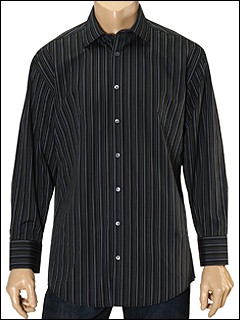
thinnish stripes in blue and green. And, although I didn't notice until later, black and blue and green were also the colours that made up this person's eye colour. I don't know whether subconsciously that's why I liked it, or whether I liked it without noticing that, and then when I noticed the eye colour later I had a "Hey!" moment, but in any case now when I remember that shirt I remember that it was all the colours of the person's eyes, as if those colours had been tidied away from each other and laid out in smooth stripes on a flat surface (the background turning into a stripe when the other strands were placed on top of it): as if the person's eyes were pouring themselves down their torso. I liked that shirt, anyway, but to like it more because it seems to extract something of the person's physicality into itself...there ought to be a figure of speech for that.
Funny.
16 November 2008
In Which I Talk about Sex (and a Bit More)
In one of the James Bond novels the narrator offers a brief rumination about pain. He says, to paraphrase, that the human body forgets the physical sensations of pain very quickly: you can remember that you were in pain, and that it was very painful, but you cannot remember (which means, I suppose, recreate) the sensations of pain, or the sensation of their actual painfulness, for very long. I think the same is true of sex. I'd say you get about two days, but let's call it a week just be certain. That's how long you can recreate the actual sensations of sex, the physical experience of its pleasure. After that, you can remember that you had sex, and that you liked it very much indeed, but you've got no sensation to tide you over. And that, I think, is why when people long for sex, or fear they'll never have it again, they do so with such yearning and despair: because you've got no sensation memory to buoy you up.
And now we move naturally from sex to...David Tennant (of course we do). And, since I love

pictures of David Tennant, let's have a picture to go with the topic, shall we? I wanted to pick one in which he just looks nice, because tonight's Topic with Relation to David Tennant is, in fact, niceness.
So, not very long ago (as you will know if you read some of these blog entries) I was involved with a man. And then I wasn't. Well, that's a story that's old in the world, and as tedious to those involved as to those watching or reading it, so let's skip the whys and wherefores and get to the point. Which is, after it was all over and people were trying to be helpful, one thing they did to be helpful - and, indeed, one thing I did myself - was to see if there was something about this person that was, perhaps, applicable to other people, so that when I was done mourning and ready to go on, I would be able to get some larger meaning or use by looking for that attribute in other people. So a number of people asked me why I'd liked the person, or what had attracted me to him. And my answer was always, "...He was nice." Which is true. Of course what first drew my eye was how he looked, and what first made me make contact with him was that he said something really smart to me, but the reason why I stuck to him was because...he was nice.
Nice doesn't mean kind, or thoughtful, or remembering your birthday or holding doors open (although all those things are good, and devoutly to be wished in a boyfriend). And nice doesn't mean anything weak or derogatory, although it is usually a weak word, and often used in a derogatory sense. I think the best definition of it that I could offer is that nice means accepting people as they are, and genuinely engaging with them as they are. The thing that was so great about this person was that he never flinched. I told him some stuff that I'd never told other people - not terrible stuff, in fact quite mild stuff by most people's measurement, I suppose, but stuff that I was shy of revealing, or that I felt put my self on the line in some way - and not only did he never snicker, or hold it against me, but he never acted as if it were anything out of the ordinary way of information. He didn't denigrate any of my worries or weirdnesses; he just treated them as if they were normal: treated them as not very important, in a good way. And he did nice things without making a song and dance about it. He brought me presents for no reason, but he didn't seem to expect anything for them; it was as if he just did it for the pleasure of it. The sense I got was that he wasn't trying to be that person; he just was that person: nice.
Now, I don't know, but whenever I see David Tennant interacting with the public as himself, he seems that way, too. It's as if it's no big deal to him to do what makes other people happy, and as if quite a lot of things that other people might find odd or worth being at least a little bit obnoxious about are things that he's willing to throw himself into - no skin off his nose, as my dad would say (see this clip from the Graham Norton show, where the situation actually starts at 8:05 of this clip). It could all be faked, or it could be true but he's still a terrible person in private, but his public persona suggests simply that....he is nice.
I think nice is under-rated. Or maybe it's just under-rated with reference to me. Everybody thinks people want to be thought incredible, or put on a pedestal, or...or...what? Lauded. And I think people do want that, in a way. I mean, everyone wants to think that the person they're with thinks they're special. But I know that I, at least, want most of all just to be accepted. Or maybe it would be better to say, "liked," because that allows for the presents as well as the matter-of-fact reaction to odd stuff. Bringing someone a present in a matter-of-course way, or letting them ruffle your hair, as David Tennant does here (at 2:50 - incidentally, I find it interesting that he seems to like wearing all three pieces of three-piece suits), suggests that you have in some way absorbed them into the part of your life where you don't think, aren't fussed about them, where you relate to them rather than are at one remove from them. It's hard to explain, or maybe you already see what I mean. I think it's that I think, really, that that quieter connection is much more real, and much more an expression of how the person values you and other people, than any kind of frenzy of love. David Tennant's saying, "Sure, go on, ruffle my hair" suggests that he doesn't view his fans as weird - that he thinks of them as people. ARGH. I said it was hard to explain. But I think most people really don't do this: they don't know how to let other people in, or they're afraid to do so. So "nice" equals "connective" for me.
So I guess the lesson here is that I value quiet acceptance over big adoration. God, I really am British.
You know, I sometimes think that I'm going to do everything I can to get famous in a sensible way, JUST so I can hang out with David Tennant once.
Subscribe to:
Posts (Atom)
Subscribe To


 Posts
All Comments
Posts
All Comments
